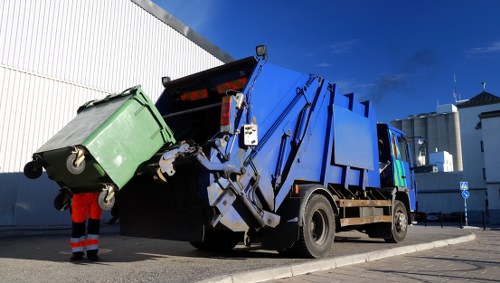
Recycling and Sustainability for House Clearance Kilburn
House Clearance Kilburn takes an eco-first approach to every job. Our commitment to creating a greener, more sustainable rubbish area in Kilburn means diverting as much material as possible away from landfill and into reuse, repair and proper recycling streams. We treat every clearance as an opportunity to recover value and reduce carbon.We set clear targets so our operations drive measurable change: our company-wide recycling percentage target is to achieve a 75% recycling and reuse rate by 2028 across all clearances and collections. That target covers bulky household items, building waste from small renovations, electronic waste and textiles. By combining on-site sorting with partnerships and low-impact transport we steadily increase the proportion of material that goes back into the circular economy.
 Our approach to sustainable rubbish management in Kilburn respects local borough policies and the practicalities of urban clearances. We coordinate with council systems so that recyclable streams — paper, glass, mixed plastics, food waste and garden cuttings — are separated wherever possible. That alignment helps House Clearance services in Kilburn fit cleanly into the wider borough strategy for waste separation and resource recovery.
How we manage recycling and separation
On-site sorting is central to our process: we segregate items into reuse, repair, recycling and residual at the earliest stage. This reduces contamination of recyclable materials and improves the quality of loads delivered to processing centres. We also use small interim storage containers and labelled bags to align with Brent and Camden collection guidelines.We work with local authority schemes and comply with the boroughs' approach to waste separation. Typical streams we coordinate with include:
- Mixed dry recycling (paper, card, some plastics)
- Glass and metal containers
- Food waste where collection is available
- Textiles and small WEEE (electricals) diverted to specialist processors
 Partnerships with charities are a major part of our reuse strategy. We work with local and national not-for-profits including Age UK, Emmaus and furniture reuse charities to ensure good-quality items get an extended life. Donated furniture and working appliances are collected and channelled to charity shops and social enterprises that serve Kilburn and the surrounding communities.
Supporting the local network of transfer stations helps us close the loop. We routinely deliver sorted loads to nearby council recycling centres and transfer stations such as the Brent Recycling Centre (Welsh Harp) and Barnet/Hendon facilities, and to authorised regional transfer and resource recovery parks. These centres accept separated streams and route materials to specialist processors for re-manufacture or energy recovery where necessary.
Recycling activity and material types
Our teams routinely handle:- Bulky furniture for reuse and refurbishment
- WEEE (white goods, TVs, small appliances) sent to certified recyclers
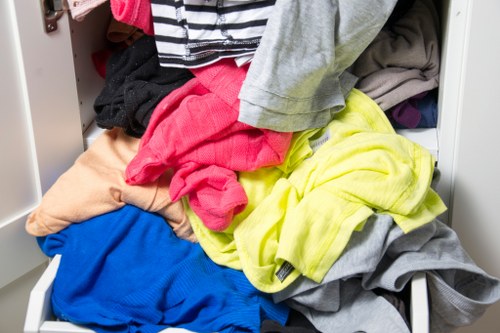
- Textiles and mattresses directed to charity reuse or specialist recycling
- Hazardous household items (paints, solvents, batteries) taken to council household waste recycling centres for safe processing
We avoid contamination by pre-sorting on-site, following borough guidance for how residents in Brent and Camden separate waste. This practical alignment increases recovery rates and reduces processing costs and carbon intensity of material handling.
Our transport fleet and logistics are designed for a low-carbon footprint. We deploy low-carbon vans including battery-electric vehicles for urban clearances and the cleanest available Euro 6 vehicles for longer trips. Route optimisation and consolidated drop-offs minimise empty runs and reduce emissions per tonne collected. For small central-London jobs we also use cargo bikes and micro-delivery where access and scheduling allow.
 Monitoring and reporting are part of how we demonstrate progress. We record weights and destinations of materials leaving each site and publish internal performance against our 75% target. Monthly reporting enables us to identify problem streams, reduce contamination and improve training for crews so that more items are captured for reuse instead of being lost to residual waste.
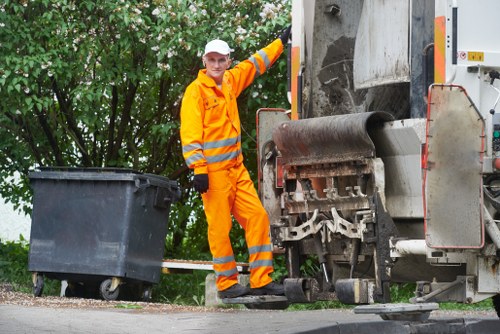 Community engagement is critical: we host local collection events and partner with neighbourhood groups to promote textile banks, battery recycling and WEEE take-back. By collaborating with community organisations, charities and borough transfer stations we amplify the impact of Kilburn house clearance activity and support a stronger local circular economy. Every cleared home is a chance to recover materials, reduce carbon and support social value through donations and reuse.
In conclusion, House Clearance Kilburn focuses on delivering a sustainable service that aligns with borough waste separation policies, local transfer station processes and charity partners. Our measurable recycling targets, low-carbon van use and structured reuse pathways ensure that clearances in Kilburn become a positive force for the environment and the community.
We continue to refine our systems, increase the proportion of material reused or recycled and work with transfer stations and processing partners to meet the evolving needs of the capital. By prioritising sustainable rubbish area practices and circular-economy partnerships, Kilburn clearances can be both efficient and environmentally responsible.
Our message is simple: choose an eco-friendly waste disposal partner that measures results, donates usable items to charities, uses low-emission vehicles and coordinates with local recycling infrastructure to deliver better outcomes for Kilburn and the wider boroughs.